


A friend of mine opened a small bakery three years ago. She made the best cinnamon rolls in town, had loyal customers lining up before opening hours, and still nearly closed shop within her first year. Not because the food was bad. Not because customers stopped coming. She lost money because she was tracking expenses on sticky notes and had no idea her supplier was overcharging her for flour by almost twenty percent.
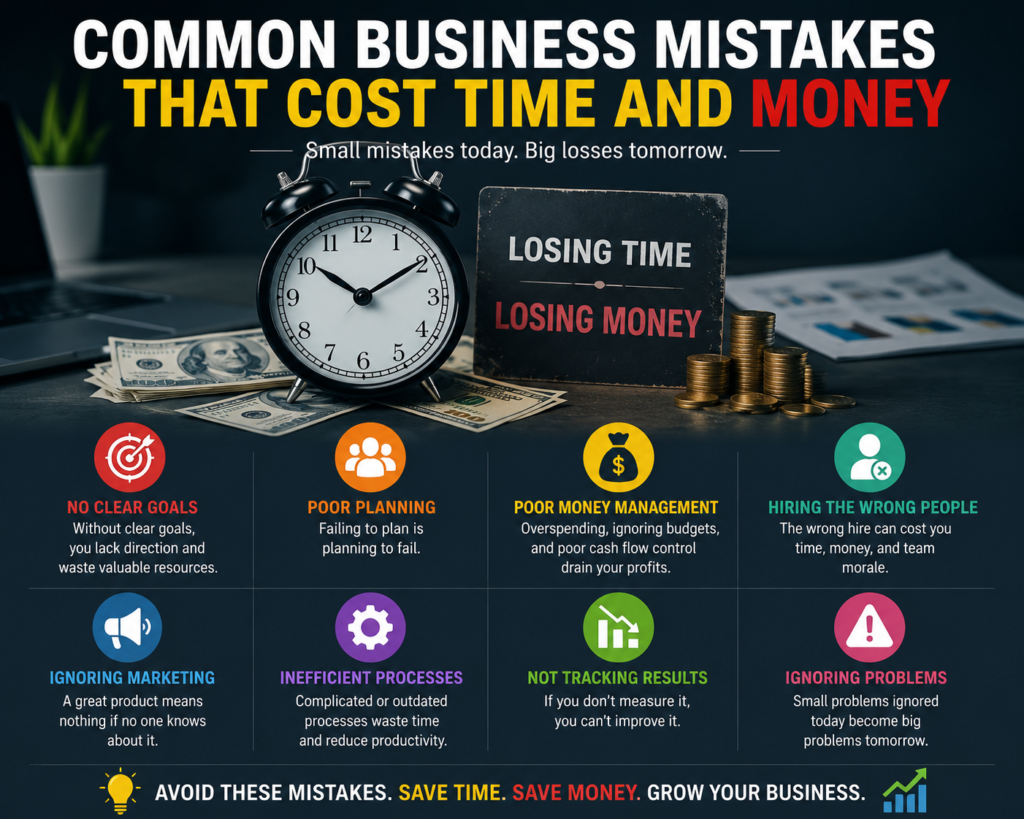
That story stuck with me because it’s not rare. Talented people build good products and still bleed money through cracks they never noticed. Business mistakes rarely look dramatic when they happen. They look like a skipped invoice, a missed follow-up email, or a software subscription nobody remembers signing up for.
This article walks through the mistakes that quietly drain time and cash from businesses, big or small, based on patterns I’ve seen repeat again and again in real setups. Some of these might sting a little if you recognize yourself in them. That’s fine. Recognizing the problem is the whole first step.
Why Small Mistakes Turn Into Big Losses
Here’s something nobody tells new business owners: it’s rarely one giant blunder that sinks a business. It’s usually five or six small habits stacking on top of each other for months.
A missed invoice here. A double-booked meeting there. A marketing campaign that ran for weeks with a broken link. None of these feel catastrophic on their own. But add them up over a year and you’re looking at thousands of dollars and hundreds of hours gone for nothing.
Think of it like a leaking faucet. One drop doesn’t matter. A thousand drops a day adds up to gallons of wasted water by the end of the month.
Mistake #1: Not Tracking Where Money Actually Goes
This is the most common one, and it’s the one that hurt my bakery friend the most.

Plenty of small business owners run their finances through a mix of bank statements, a notebook, and memory. That works fine until it doesn’t. The moment you have more than a handful of transactions a week, things start slipping through.
I’ve watched business owners discover, months later, that they were paying for two project management tools doing the exact same job. Nobody canceled the old one when they switched to the new one.
What actually helps:
- Use accounting software from day one, even if your business is tiny. QuickBooks, Wave, or FreshBooks all work well depending on your budget. Wave is free and handles basic invoicing and expense tracking just fine for a solo operation.
- Set a recurring reminder, once a month, to review every subscription and recurring charge on your bank statement. You’ll be surprised what turns up.
- Separate business and personal accounts immediately. Mixing them makes it nearly impossible to know your real profit.
My bakery friend switched to Wave after that flour incident. Within two months she caught another supplier quietly raising prices without telling her. That single review habit paid for itself many times over.
Mistake #2: Hiring Too Fast (or Too Slow)
Hiring mistakes are expensive in a way that doesn’t show up immediately. You feel the pain three months later when the wrong person is still learning the ropes while your actual work piles up.
I once consulted for a small marketing agency that hired two new account managers within the same month because they landed a big client. Neither hire had proper onboarding. The client left within a quarter because communication was a mess. The agency spent more money on those two salaries than they earned from the client that triggered the hiring spree in the first place.
On the flip side, waiting too long to hire creates its own cost. Business owners who insist on doing everything themselves often end up as the bottleneck. Deals stall, emails go unanswered for days, and growth stalls because one person can’t be in five places at once.
A more balanced approach:
- Hire based on actual workload data, not fear or excitement. If your team is consistently working late for two months straight, that’s a signal, not just a busy season.
- Build a simple onboarding checklist before your first new hire ever starts. Even a one-page document beats throwing someone into the deep end.
- Consider contractors or freelancers first for uncertain workloads. Platforms like Upwork or Fiverr let you test whether a role is truly needed before committing to a full-time salary.
Mistake #3: Ignoring Contracts and Fine Print

This one sounds boring, and that’s exactly why people skip it.
A friend running a small design studio once agreed to a client project over a phone call and a friendly handshake energy. No written scope, no payment terms in writing, just good vibes. Halfway through, the client kept adding requests, calling them “small tweaks,” while refusing to pay anything extra. The project that should have taken two weeks stretched to two months, unpaid for the extra time.
Contracts aren’t about distrust. They’re about making sure both sides remember what was agreed upon once emotions or memory get fuzzy weeks later.
Steps worth taking:
- Always put scope of work, deadlines, and payment terms in writing, even for small projects.
- Use simple tools like HelloSign, PandaDoc, or even a well-written Google Doc with e-signature to formalize agreements quickly.
- Include a clause for revisions. Something like “two rounds of revisions included, additional rounds billed hourly” saves endless back and forth.
- Read vendor contracts fully before signing, especially the cancellation and auto-renewal sections. Many software subscriptions auto-renew annually with a narrow cancellation window buried in section nine.
Mistake #4: Spreading Marketing Too Thin
New businesses often try to be everywhere at once. Instagram, TikTok, Facebook, email newsletters, a blog, maybe a podcast too. The result is usually mediocre presence across five platforms instead of a strong one on a single channel where the actual audience lives.
I saw this with a local fitness studio that tried running Instagram Reels, a YouTube channel, and a weekly email all at the same time with a team of two people. Content quality dropped everywhere because attention was split too many ways. Once they picked Instagram as their main focus and treated everything else as secondary, engagement actually went up despite doing less overall.
Better approach:
- Pick one primary platform based on where your actual customers spend time, not where you personally enjoy posting.
- Batch content creation. Spend one afternoon a week filming or writing several posts instead of scrambling daily.
- Use scheduling tools like Buffer or Later so posting stays consistent without daily manual effort.
- Track what content actually converts into sales or bookings rather than just likes. Vanity metrics feel good but don’t pay rent.
Mistake #5: Underpricing Out of Fear

This mistake is emotional more than practical, and it’s incredibly common among freelancers and small business owners just starting out.
The fear goes something like this: “If I charge what I’m worth, nobody will hire me.” So prices get set low, sometimes barely covering costs, just to win the first few clients.
The problem is that low prices attract clients who care mostly about price, not quality. Those clients tend to demand more for less and are the first to complain or ask for extra work without extra pay. Meanwhile, raising prices later feels nearly impossible once existing clients get used to the old rate.
A photographer I know charged fifty dollars for a full wedding shoot when she started, terrified of scaring clients away. She was exhausted, barely profitable, and burnt out within a year. When she finally raised prices to a realistic rate, she lost a few price-sensitive clients but gained better ones who valued her work and paid on time.
A healthier pricing approach:
- Calculate your actual costs first, including your time, before setting any price. Time is not free even when you’re the one doing the work.
- Research what others in your field genuinely charge, not the lowest examples you can find online.
- Build in small price increases every year rather than one dramatic jump that shocks long-term clients.
Mistake #6: Poor Time Management and Constant Multitasking
Jumping between five tasks doesn’t make you more productive. It usually makes each task take longer because your brain needs time to refocus every single switch.
I’ve watched business owners answer emails during meetings, work on invoices while on client calls, and check social media notifications every few minutes throughout the day. By evening, they feel exhausted despite having little to show for the actual hours spent.
Practical fixes that genuinely work:
- Block specific hours for specific tasks. Mornings for deep work, afternoons for meetings and emails, for example.
- Turn off non-essential notifications during focused work blocks. Apps like Forest or Focus To-Do can help build this habit.
- Use a single task management system instead of scattered sticky notes and mental lists. Trello, Asana, or even a simple Notion board keeps everything visible in one place.
- Batch similar tasks together. Answer all emails at set times rather than reacting to each one as it arrives.
Mistake #7: Not Following Up With Leads or Customers
This one costs businesses enormous amounts of revenue quietly, without anyone noticing the loss.
Someone fills out a contact form, gets excited about your product, and then hears nothing back for four days because the message sat unread in a crowded inbox. By the time you reply, they’ve already booked with a competitor who responded within the hour.
A local plumbing company I spoke with discovered nearly a third of their inquiries were never followed up on at all. Not because the leads weren’t valuable, but because messages got lost between texts, voicemails, and a shared email inbox nobody checked consistently.
Steps to fix this:
- Centralize all inquiries into one system. A simple CRM like HubSpot’s free tier or Zoho CRM keeps every lead visible instead of scattered across platforms.
- Set a rule for response time, ideally within a few hours during business days.
- Use automated acknowledgment messages so leads know they’ve been heard even before a full reply goes out.
- Follow up more than once. Many people intend to reply but genuinely forget. A gentle second message often closes deals that seemed dead.
Mistake #8: Skipping Regular Financial Reviews
Plenty of business owners check their bank balance and assume that number tells the whole story. It doesn’t. A healthy-looking balance can hide upcoming expenses, unpaid invoices owed to you, or seasonal dips that catch you off guard.
Without regular financial reviews, problems compound silently until a tax deadline or a slow season forces a painful reckoning.
What a simple monthly review should include:
- Total income versus total expenses for the month
- Outstanding invoices that clients haven’t paid yet
- Upcoming fixed costs like rent, software, or payroll
- Comparison against the previous month to catch unusual patterns early
This doesn’t need to take hours. Thirty minutes once a month with your accounting software open is often enough to catch problems before they grow.
Mistake #9: Ignoring Customer Feedback Until It’s Too Late
Negative feedback feels uncomfortable, so it’s tempting to brush it aside or respond defensively. But feedback, even the harsh kind, usually points directly at something worth fixing.
A restaurant owner I know used to delete negative reviews from his mind the moment he read them, telling himself the customer was simply having a bad day. Multiple reviews mentioned slow service during weekend dinners. He ignored the pattern for nearly a year until weekend reservations noticeably dropped. Once he finally added an extra server for weekend shifts, reviews improved and bookings recovered within two months.
A better habit:
- Read reviews and feedback regularly, not just when business feels slow.
- Look for patterns across multiple pieces of feedback rather than reacting to a single comment.
- Respond publicly and calmly, even to negative reviews. Customers reading your response matter as much as the original reviewer.
- Actually implement changes based on repeated feedback rather than just acknowledging it politely.
Mistake #10: Trying to Do Everything Manually
Automation gets a bad reputation for feeling impersonal, but plenty of repetitive tasks genuinely don’t need a human doing them manually every single time.
Scheduling meetings back and forth over email, manually sending the same invoice reminder every month, or copying data between spreadsheets are all tasks that eat hours without adding real value.
Where automation genuinely helps:
- Use Calendly or similar scheduling tools instead of endless back-and-forth emails to find meeting times.
- Set up automatic invoice reminders through your accounting software instead of manually chasing late payments.
- Connect apps using Zapier to move data automatically between tools like your CRM, email platform, and spreadsheets.
- Automate social media posting schedules rather than manually posting at specific times every day.
None of this replaces genuine human connection with customers. It simply frees up time for the parts of the business that actually need a real person’s attention.
Real Example: Putting It All Together
Let’s go back to my bakery friend for a moment, since her story shows how these mistakes rarely happen alone.
She was tracking money on sticky notes, hired her first employee without any onboarding plan, agreed to a supplier contract without reading the renewal terms, and posted inconsistently across three social platforms she barely had time for.
Fixing all of it at once felt overwhelming, so she tackled one mistake at a time over about four months. First came the accounting software. Then a simple written onboarding checklist for her next hire. Then she renegotiated her supplier contract after finally reading the terms carefully. Social media got trimmed down to just Instagram, posted consistently three times a week instead of randomly across multiple platforms.
Her profit margin improved by close to fifteen percent within six months, not because sales increased dramatically, but because the leaks were finally patched.
A Few Mistakes Worth Avoiding as You Fix Things
While correcting these issues, it’s easy to swing too far in the opposite direction. A few things worth watching for along the way:
- Don’t switch software tools every few weeks looking for a perfect system. Pick reasonable tools and stick with them long enough to actually learn them.
- Don’t automate customer-facing communication so heavily that it feels robotic and cold. People still want to feel heard.
- Don’t overcorrect pricing by doubling rates overnight. Gradual, reasonable increases keep trust intact.
- Don’t ignore small wins along the way. Fixing even one of these mistakes usually creates noticeable relief within weeks.
Final Thoughts
Running a business rarely fails because of one huge, obvious disaster. It usually wears down slowly through habits that felt harmless at the time. A skipped invoice review here, a rushed hire there, a contract nobody bothered reading in full.
The good news is that none of these fixes require massive budgets or complicated systems. A free accounting tool, a written checklist, a scheduling app, and thirty minutes a month for financial review can quietly save thousands of dollars and countless hours over a year.
If you recognize even two or three of these mistakes in your own business right now, that’s a completely normal place to be. Pick one, fix it this month, and move to the next once it feels manageable. Small, steady corrections tend to outlast dramatic overhauls anyway.