
My grandfather kept a small wooden box in his closet for as long as I knew him. Inside sat a handful of letters, a rusted medal, and a photograph of men standing in front of a tank somewhere in France. He rarely talked about any of it.
After he passed, I finally sat down with those letters properly. Honestly, most of what I thought I knew about World War I came from a rushed high school unit crammed between other topics. Reading his actual words changed how the whole subject felt. Less like a textbook chapter, more like something real that happened to real people.
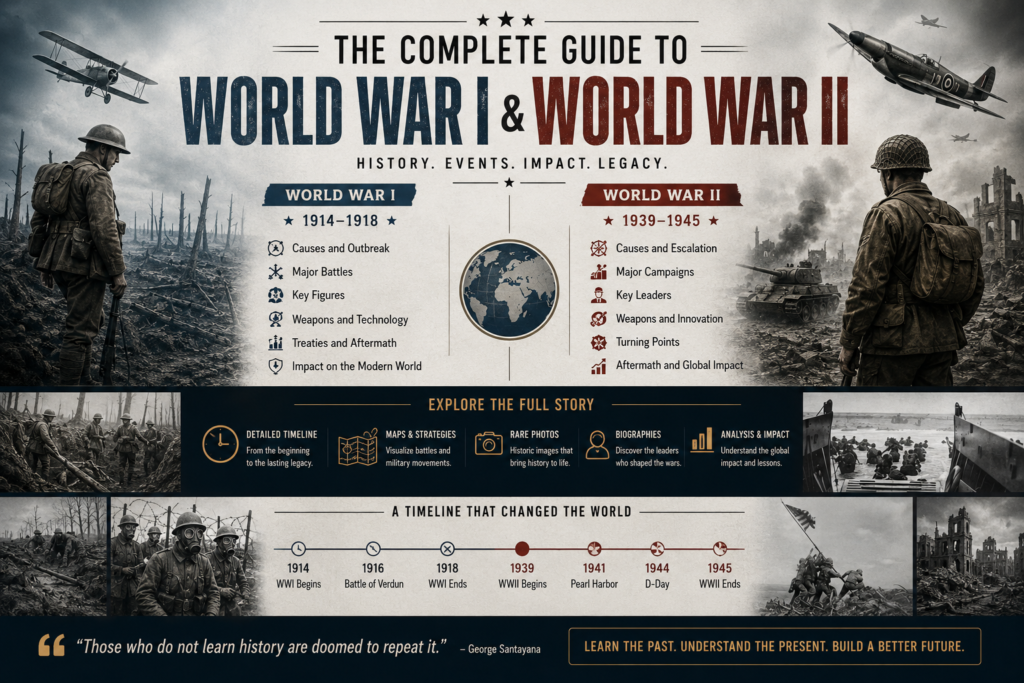
That box eventually sent me down a genuine rabbit hole. Museum visits, documentaries, old newspaper archives, and eventually a research trip to a war cemetery in Belgium. Along the way I corrected quite a few misconceptions I’d carried since school. I also picked up a clearer picture of how these two wars actually connected to each other.
This guide pulls together what I’ve learned. I’ve explained it the way I wish someone had explained it to me originally, without assuming you already know the terminology or timeline.
Why These Two Wars Get Confused So Often
Most people learn about both wars back to back in school. That oddly makes them blur together rather than stand apart clearly.
World War I ran from 1914 to 1918. World War II followed roughly two decades later, from 1939 to 1945. They involved different alliances, different technology, and largely different root causes. One war did, however, genuinely help set the stage for the other.
Understanding them as connected but distinct stories made everything click for me.
World War I: How It Actually Started
I always assumed World War I started because of one single event, the assassination of Archduke Franz Ferdinand. Turns out that assassination was more like a spark landing on already dry, flammable material.
Europe had spent years building tense alliances and aggressive militaries. Nationalist tensions between empires simmered underneath it all. Once Austria-Hungary blamed Serbia for the assassination, a web of alliance treaties pulled country after country into the conflict within weeks.
The major players involved
The Allied Powers included France, Russia, Britain, and eventually the United States. The Central Powers included Germany, Austria-Hungary, and the Ottoman Empire.
What made this war so different
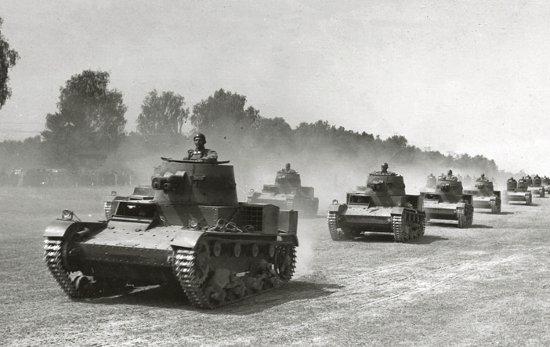
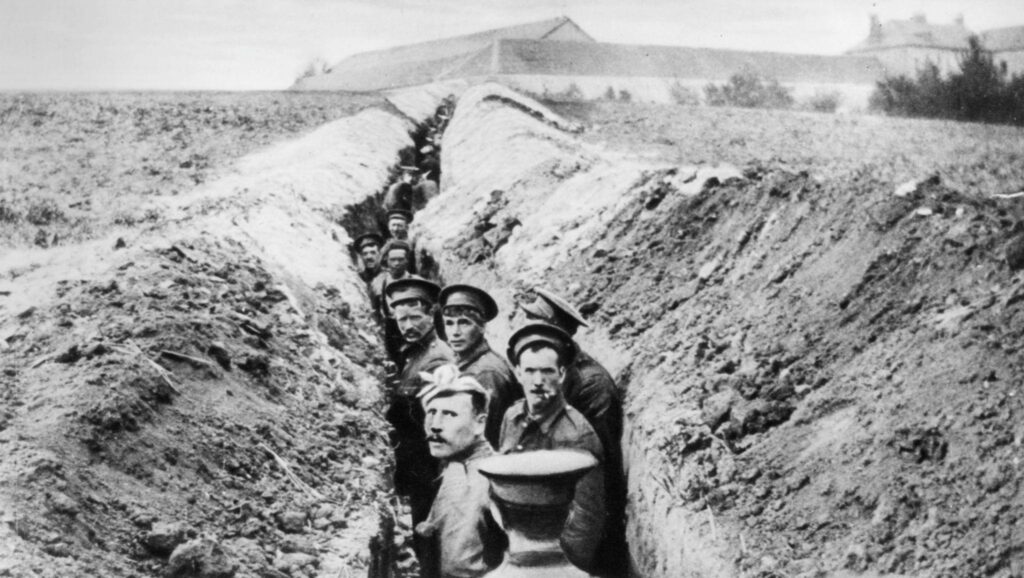
Trench warfare defined much of World War I. Soldiers dug into long, muddy trenches facing each other across a deadly stretch of land nicknamed “no man’s land.” New weapons, machine guns, poison gas, and tanks, made this war far deadlier than anything seen before.
Visiting a preserved trench system in France years later gave me a genuinely uncomfortable understanding of just how brutal those conditions actually were. Cramped, muddy, and constantly under threat.
How World War I Ended, and Why That Ending Mattered
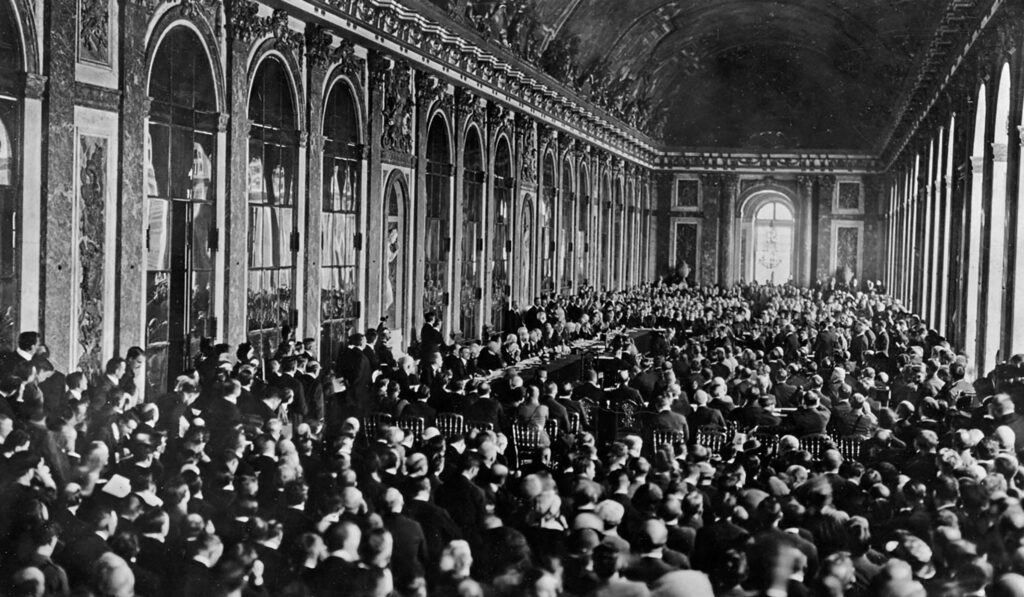
The war ended in November 1918 with Germany’s surrender. The Treaty of Versailles followed in 1919.
That treaty placed harsh financial and territorial penalties on Germany, intended to prevent future aggression. Instead, the resulting economic hardship and national resentment created fertile ground for extremist political movements over the following decade.
I used to think of these two wars as completely separate stories. Learning how directly the aftermath of World War I fed into the conditions leading to World War II reframed the entire subject for me.
The Years Between the Wars
Germany faced severe economic collapse during the 1920s. This included a period of hyperinflation so extreme that people reportedly needed wheelbarrows of currency just for basic groceries.
That instability created an environment where extremist parties gained real traction. Widespread unemployment and national humiliation from the Versailles Treaty made things worse.
Adolf Hitler and the Nazi Party rose to power during this period. They promised economic recovery and restored national pride. By 1933, Hitler held complete control over Germany’s government.
World War II: How It Actually Began
Germany invaded Poland on September 1st, 1939. Britain and France declared war on Germany shortly afterward, officially beginning World War II in Europe.
Meanwhile, tensions had been building separately in the Pacific. Japan pursued aggressive territorial expansion across Asia throughout the 1930s.
The major alliances this time around
The Allied Powers eventually included Britain, the Soviet Union, the United States, and France, among others. The Axis Powers consisted primarily of Germany, Italy, and Japan.
Key Turning Points Worth Understanding
I used to think World War II was one continuous, predictable march toward Allied victory. Researching it properly showed a far messier, less certain reality.
Pearl Harbor brought the United States into the war directly
Japan’s surprise attack on the American naval base at Pearl Harbor happened in December 1941. It pushed the United States into full involvement, dramatically shifting the war’s overall balance.
The Holocaust remains history’s darkest chapter
Nazi Germany systematically murdered six million Jewish people. Millions of other victims died too, including Roma people, disabled individuals, and political prisoners. This stands as one of history’s most horrific atrocities. Visiting a Holocaust memorial museum left an impact on me that no textbook chapter ever came close to matching.
D-Day marked a major turning point in Europe
Allied forces launched a massive invasion of Normandy, France in June 1944. This opened a crucial western front against Germany. Walking those beaches decades later, now peaceful and quiet, felt genuinely surreal knowing what happened there.
The war in the Pacific ended with atomic weapons
The United States dropped atomic bombs on Hiroshima and Nagasaki in August 1945. This led directly to Japan’s surrender and the war’s official end.
How the Two Wars Actually Compare
Scale and casualties
World War I resulted in roughly 17 million deaths. World War II proved dramatically deadlier. Estimates run between 70 and 85 million deaths when including civilian casualties, making it the deadliest conflict in human history.
Technology changed dramatically between them
World War I introduced early tanks, machine guns, and chemical weapons. World War II brought far more advanced aircraft, aircraft carriers, and ultimately nuclear weapons. This technology fundamentally changed warfare permanently afterward.
Global impact and lasting consequences
World War I reshaped European borders. It also led directly to conditions enabling World War II. World War II reshaped the entire global political order. It led to the creation of the United Nations, the beginning of the Cold War, and decades of geopolitical tension that followed.
How I Actually Learned This Material Properly
Reading a single textbook chapter never gave me a genuine understanding of either war. Combining several different approaches actually helped.
Step-by-step approach that worked for me
- Start with a documentary series for a broad overview. Something like “The World Wars” or Ken Burns’ documentary work provides accessible entry points.
- Visit a museum or memorial site if possible. The Imperial War Museum in London and the National WWII Museum in New Orleans both offer genuinely powerful, well-organized exhibits.
- Read personal accounts or letters, if any exist in your own family history. Pair these with published diaries like Anne Frank’s writing during World War II.
- Use a genealogy platform like Ancestry or Fold3 if you’re curious about family members who served. Military records often reveal surprising personal details.
- Follow up with a well-researched book on a specific event that interests you. Avoid trying to absorb everything simultaneously.
Breaking the material into smaller, connected pieces made everything far more memorable. Trying to memorize a single sprawling timeline all at once never worked nearly as well.
Common Misconceptions Worth Correcting
I genuinely believed for years that World War I started purely because of one assassination. That belief missed the deeper alliance and nationalism tensions building beforehand.
Many people assume the United States entered World War II immediately after it began in Europe. In reality, direct American involvement didn’t happen until Pearl Harbor, over two years later.
Another common misunderstanding treats the Holocaust as a side event within the larger war. It should instead be understood as a central, deliberate genocide carried out systematically throughout the conflict.
Some assume World War I and World War II happened for essentially the same underlying reasons. While connected historically, they involved different immediate causes, different alliances, and different global contexts entirely.
Why Understanding This History Genuinely Matters
Beyond academic interest, this history offers something more practical. Understanding how economic collapse, national resentment, and unchecked extremism contributed to World War II helps us recognize similar warning signs today.
My grandfather rarely spoke about his experience. I understand now that silence was probably its own kind of protection from memories too painful to revisit regularly.
Learning this history properly gave me a much deeper appreciation for what previous generations actually endured. A rushed classroom unit never fully conveyed that.
Resources Worth Exploring Further
Documentaries like “The World at War” and Ken Burns’ World War II series offer accessible, well-researched starting points for beginners.
The Imperial War Museum and National WWII Museum both offer virtual tours and extensive online archives. This works well if an in-person visit isn’t currently possible.
Genealogy platforms like Ancestry, Fold3, and the National Archives website let anyone curious about family military history search actual service records directly.
Books like “The Guns of August” by Barbara Tuchman and “The Rise and Fall of the Third Reich” by William Shirer remain widely respected. Both offer deeply researched starting points for readers wanting genuine depth beyond a general overview.
A Few Things Worth Keeping in Mind
Historical interpretation continues evolving as new records get discovered and studied by historians. Treat any single source, including this guide, as a starting point rather than the complete, final word on such an enormous topic.
This overview simplifies an incredibly complex, multi-decade span of history into a manageable introduction. Countless important events, figures, and nuances exist beyond what a single article can properly cover.
Final Thoughts
That small wooden box eventually led me somewhere I never expected. I stood quietly in a war cemetery reading names of men who never made it home. Later I walked through a preserved trench system, understanding just a little better what my grandfather actually lived through.
History like this deserves more than a rushed classroom unit squeezed between other subjects. It deserves the kind of attention that turns names and dates into genuine understanding of what actually happened and why it still matters.
Maybe you have your own family connection to either war, even a small one. That’s often the best possible starting point. Following that personal thread tends to make the broader history stick in a way no textbook manages on its own.