

Some of Ashoka’s pillars still stand today. They’re scattered across present-day India and Pakistan. A few even influenced the national emblem of India.
His greatness isn’t that he was perfect from the start. It’s proof that a leader can completely rework his thinking once he realizes how much harm he was causing. That change can end up mattering more than anything he did before it.
What I Learned From Studying These Leaders
Instead of pretending I got everything right from the beginning, I thought it would be more useful to write down where I went wrong. Nobody gets this right on the first try, and I certainly didn’t.
Mistake One: Treating Them Like Perfect Heroes
My first mistake was putting these figures on a pedestal. Gandhi’s personal life was far more complicated than most people acknowledge. Lincoln held views on race that were shockingly retrograde, even for his own time.
Ignoring those parts doesn’t honor a legacy. It distorts it.
Mistake Two: Expecting Instant Clarity
My second mistake was assuming that reading about someone would hand me immediate insight. I picked up Mandela’s autobiography thinking I’d finish it and become a more patient person overnight. That’s not how it works.
Patience gets built through daily challenges that actually test it. Collecting quotable lines doesn’t do the job.
What did surprise me was how much these stories reshaped my approach to conflict at work. In tense meetings, I started asking myself one quiet question: five years from now, how will this look, and is my response actually solving anything?
That single shift in perspective has talked me down from more arguments than I can count.
Mistake Three: Assuming Every Lesson Has to Come From Someone Likeable
My third mistake, and this one’s a little embarrassing, was believing useful lessons only come from people worth admiring. Some of my most valuable lessons came from leaders whose legacies are genuinely mixed.
Studying where someone failed turned out to be just as instructive as studying where they succeeded. Sometimes it taught me more.
How to Turn Casual Curiosity Into Something That Actually Sticks

If any of this sounds familiar, here’s the approach that’s worked for me.
Go Deep on One Leader Instead of Wide on Ten
I used to skim five paragraphs each on ten different leaders. Reading one complete biography turned out to be far more instructive.
I restarted this hobby with David McCullough’s biography of John Adams. That single book changed how I engage with the whole subject.
Read Their Own Words Whenever You Can
Nothing nourishes understanding like letters, speeches, and journals. Not even the best secondhand summary comes close.
Marcus Aurelius wrote his private thoughts down for no one but himself. Reading them directly hits differently than reading someone else’s interpretation.
Mix Audio With Deep, Slow Reading
I listen to podcasts like Hardcore History or Revolutions during my commute. When I want to slow down and actually digest something, I switch to a physical book or my Kindle.
Audible has made this hobby fit into an otherwise packed schedule.
Visit a Real Location Tied to Their Story, If You Can
Standing where an event actually happened changes how a story lands. A single night at the Lincoln Memorial taught me more than any documentary ever has.
Write Down How a Lesson Applies to Your Own Life
I keep a note on my phone for this. Any time a piece of biographical insight connects with something happening in my own life, I write it down.
It doesn’t need to be elaborate. A basic notes app works fine, or Notion if you want something more organized.
Talk to Someone Else About What You Learned
Explaining what you’ve learned out loud pushes your understanding further than memorizing trivia ever will. This holds true even if you’re only talking to a coworker who half listens.
Common Mistakes to Avoid When Studying Great Leaders

When people first get into this topic, myself included, a few patterns show up again and again.
Treating Leaders as Entirely Good or Entirely Evil
People are complicated. Reducing someone to a hero or a villain misses the real lessons worth learning.
I still catch myself doing this sometimes. It usually happens within the first ten minutes of a documentary that immediately paints its subject as saint or sinner.
Relying on Movies for Historical Accuracy
Movies are entertaining, but they compress decades into two hours. They often invent dialogue and events for the sake of drama.
Braveheart is a fun watch, but it gets an astonishing number of basic facts wrong.
Skipping Primary Sources
Summaries are convenient, but they strip away nuance, uncertainty, and character. A one-paragraph textbook summary of Lincoln’s presidency can’t tell you as much about the man as his actual letters can.
Rushing Through a Biography Just to Finish It
I used to treat these books like a checklist. I’d race to the end so I could cross off a name and move to the next one.
Sitting with a chapter that really lands teaches you more than blitzing through the whole book. It might take a week. If it takes a month, that’s fine too.
Forgetting to Connect It Back to Your Own Life
Trivia is fine on its own, but it only goes so far. The real value comes from what a leader’s decisions can teach you about something you’re wrestling with this week.
Putting Too Much Faith in a Single, Polished Source
Much of what we know about Ashoka’s transformation comes from edicts he had carved into stone. That’s exactly why historians treat that record with healthy skepticism.
Reading a solid overview alongside a full biography paints a far more balanced picture. Relying on one narrator alone rarely does.
Final Thoughts
Standing in front of that memorial years ago, I never expected this hobby to become so personal. It stopped being about memorizing dates and turned into a strange kind of mentorship from people who are no longer alive to mentor anyone.
What Each Leader Actually Taught Me
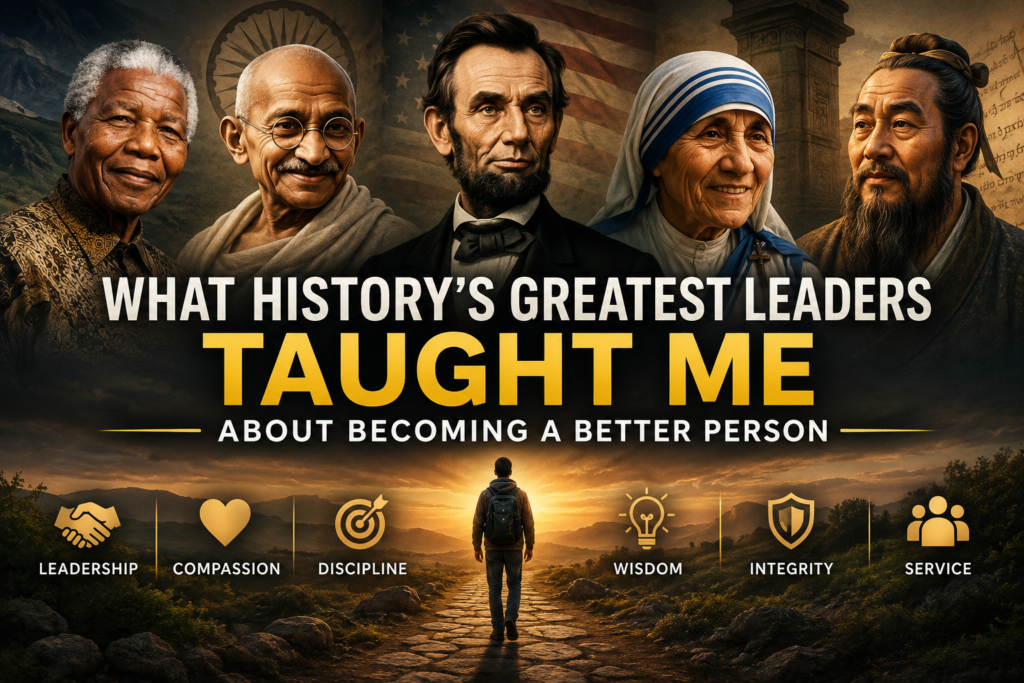
Lincoln taught me that you can hold impossible things together even while everything feels like it’s splitting apart. Mandela showed me that releasing anger can be its own form of power.
Gandhi proved that a nation can shift an entire system by refusing to play the oppressor’s game. Elizabeth I showed that limits can become your greatest tool if you’re imaginative enough. Marcus Aurelius reminded me that even the most powerful man in the world still wrestles with doubt behind closed doors.
None of them were perfect, and pretending otherwise misses the point entirely. This was never about finding a flawless case study to copy. It’s proof that ordinary human struggle, met with a little bravery and persistence, can still echo across centuries.
Where to Start
If you’re wondering where to begin, pick any leader already on your radar. Go straight to their own words first. Everything else tends to follow from there.
I still think about that night at the Lincoln Memorial more often than I’d expect from a random work trip years ago. Maybe that’s the whole point of legacy. A person’s life ends, but their choices keep gently nudging strangers like me toward being a little more patient, a little more brave, and, when possible, a little better at building things instead of tearing them apart.